
Three days, one stand, four companies. From 13 to 15 October, Damovo exhibited at Smart Country Convention in Berlin, in Hall 26 at Stand 539. We were joined by our partners Rocket.Chat, Pexip and Mitel.
Together, we showed how sovereign communications for public authorities and the public sector already work today: with SovereignStack. Telephony, messaging and meetings, under your control.
Why Sovereignty Needs to Be on the Agenda Now
Digital sovereignty is no longer a niche topic. The presentations at SCCON made that clear, too. At EU level, a framework for assessing sovereignty with four levels is taking shape, ranging from data hosted in the EU to a transparent code supply chain. Higher levels are set to carry weight in public procurement, with open source explicitly given preference. What is still a voluntary strategy today is likely to become a requirement in the foreseeable future.
Practice is already moving ahead. Schleswig-Holstein has switched its groupware, collaboration and telephony to open source, Berlin is expanding its open-source strategy, and since 2026, the EVB-IT contract templates have also referred to open source. Many public authorities are no longer asking whether to make the switch, but how.
One thought particularly stayed with us: when you buy from outside Europe, you give away knowledge, and with it, resources. Every euro spent on licences and cloud services funds research, talent and innovation where the solution is developed. Sovereign procurement is therefore also an investment in your own region.
That is exactly where our presence at the event comes in. Our message at the stand: sovereignty is not declared. It is built. With technology that is available today, proven in operation and independent of individual hyperscalers.
An Open-Source Hub, Three Partners
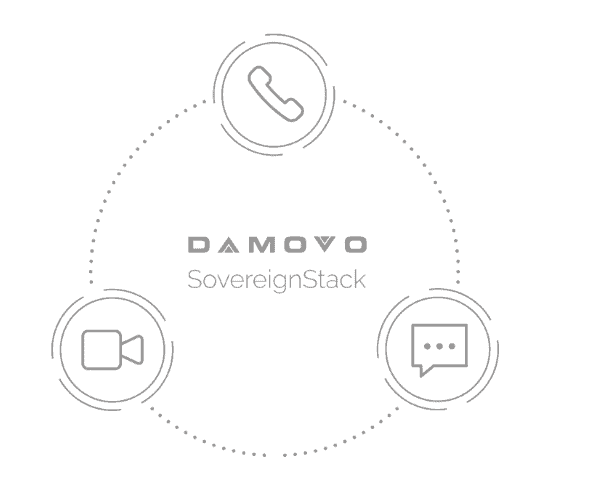
At the heart of SovereignStack is an open-source hub. Rocket.Chat sits at the centre as the open core, providing messaging, collaboration and a central client. Additional components can be connected modularly: Pexip for video conferencing that can also be operated independently in highly secure environments, and Mitel for telephony that fits into existing structures. Open interfaces and standards make it possible to connect other open-source systems just as easily as existing solutions.
Why does this matter? Sovereignty does not come from a particular licensing model. It comes from an organisation being able to make its own decisions, maintain control and switch solutions over the long term. This was one of the conference’s key messages, and it is exactly what a modular setup is designed to deliver. Every module can be replaced, and none ties you to a single provider.
Damovo brings these components together as a vendor-neutral integrator, providing consulting, implementation and operation. On-premises or in a sovereign European cloud. As a complete UC solution or as an out-of-band solution that works in an emergency when the primary platform fails. For many organisations, this is the first step towards a complete transition.
Open source. Operated in Europe.
Our Impressions
The conversations at our stand were practical and specific. Hardly anyone wanted to know why sovereignty matters. Most wanted to know what switching over would look like in practice: migration, operation, security requirements up to VS-NfD and what happens to existing licences.
The out-of-band scenario attracted particular interest. Many public authorities are looking for a second, independent layer of communication that comes into play when the primary platform is unavailable. Often, this is the pragmatic way in: start with an independent second layer, then expand step by step.
We were pleased to see how broad the interest was. Local authorities, state and federal government agencies, IT service providers for the public sector and cloud providers were all equally represented. Sovereign communications is now on the agenda at every level.
Thank You, and What Comes Next
A big thank you to Rocket.Chat, Pexip and Mitel for three great days, and to everyone who stopped by. SCCON confirmed what we already knew: the demand is there, and so is the solution.
Now it is time to put things into practice. We look forward to turning the conversations in Berlin into concrete projects. Did you miss us or want to take a closer look? Get in touch.